
Breaking Down the Numbers Behind MLB’s Hottest Prediction Markets: ERA Title Odds and the Acuña Triple Race
Over million in 24-hour trading volume is flowing through three MLB prediction markets on ERA leaders and the Acuña Jr. triples race — here's what the data says.

The intersection of prediction markets and baseball analytics creates some of the most interesting pricing dynamics in the sports wagering landscape. Three MLB-focused markets are currently generating over $2 million in combined 24-hour trading volume, all centered on season-long statistical leaders. Here is a data-driven breakdown of where those markets stand and what the numbers actually support.

Jeffrey Springs ERA Title: High Volume, Near-Zero Probability
The largest MLB prediction market by volume right now is the question of whether Jeffrey Springs leads qualified starters in ERA at season’s end, generating over $1.09 million in 24-hour volume. Current pricing sits at 0.65% yes and 99.35% no.
The stats justify that lopsided pricing without ambiguity. Springs is pitching for the Oakland Athletics in 2026 with a 3-7 record, a 5.55 ERA, and a 1.35 WHIP through 16 starts. His last seven outings have been worse — a 7.49 ERA over 33.2 innings, 0-4 over that stretch. His career ERA is 3.92 across nine seasons, but this year’s underlying data shows no credible path toward leading the major leagues among qualified pitchers.
Understanding why this market generates $1 million in daily volume despite being an effective certainty requires understanding how prediction market mechanics work. A clear “No” position is easy to acquire at a low price, and traders looking to harvest near-certain outcomes flock to high-volume, low-ambiguity markets like this one. For a deeper explanation of the dynamics at play, see our guide on how prediction markets work.
Bryan Woo ERA Title: A Legitimate Case at 0.70%
The companion market — whether Bryan Woo of the Seattle Mariners wins the ERA title — generated over $629,000 in 24-hour volume, with pricing at 0.70% yes. Unlike the Springs market, this one rewards more careful analysis.
Woo is one of the better starting pitchers in the American League by nearly every relevant metric in 2026. His career ERA through June 18 stands at 3.34. His 2026 form has been sharp in recent weeks — a 2.43 ERA and 5-1 record across his last seven starts, with a 2.76 ERA over 15 starts. His WHIP has been under 1.00 over recent stretches, reflecting elite command and an ability to limit baserunners that translates directly to low earned-run totals.
Is 0.70% undervaluing him? Not necessarily in absolute terms, but when you compare his profile to other ERA contenders, the case for relative value becomes interesting. The ERA title requires outperforming every other qualified starter in baseball over a full season, which is why even dominant pitchers are priced below 5% on these markets. The question is whether Woo is getting the same pricing as pitchers who are statistically comparable right now. For bettors who want to cross-reference prediction market data with traditional sportsbook pricing, our analysis of prediction markets vs. sports betting lays out the key structural differences.
For direct access to these markets, the Polymarket promo code page has current welcome offers. Kalshi also operates robust season-long baseball markets, and our full Polymarket review breaks down the platform’s features, fee structure, and sports-market depth for new traders.
Ronald Acuña Jr. Triples Leader: Speed vs. Profile
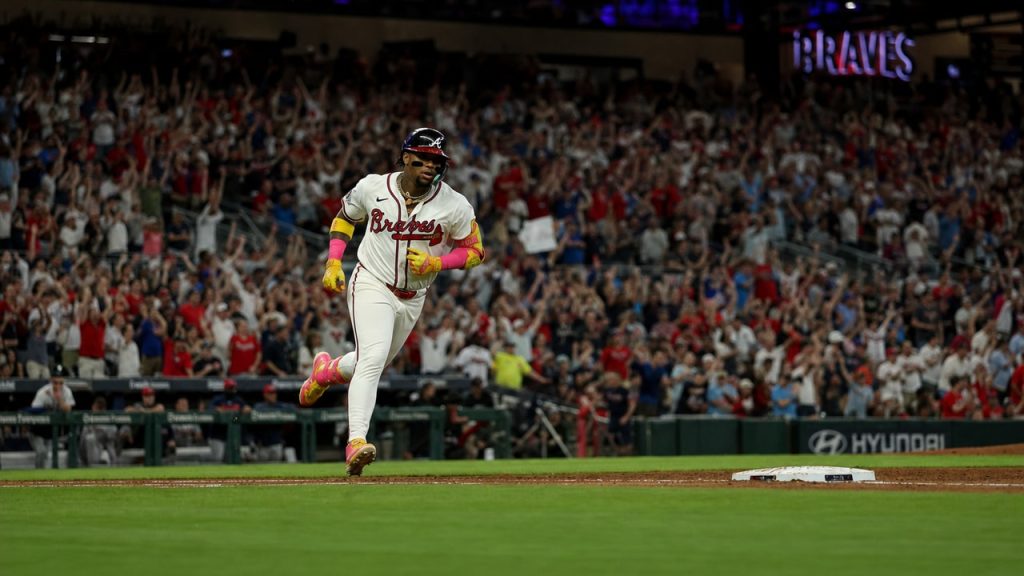
The third market covers whether Ronald Acuña Jr. leads the majors in triples this season, with over $335,000 in 24-hour volume at 0.55% yes. Acuña plays right field for the Atlanta Braves and is among the most athletically gifted players in the game, but the triples-leader market creates an interesting tension between raw talent and hitting profile.
Through 53 games in 2026, Acuña has 195 at-bats, a .251 average, a .373 OBP, a .421 slugging percentage, 7 home runs, 22 RBI, and 15 stolen bases. He has one triple on the season. His speed and athleticism are not in question — 15 stolen bases through 53 games confirms his elite baserunning ability. But the triple leaderboard is typically dominated by hitters who pull balls to deep gaps in stadiums with large outfields, and Acuña’s power-plus-on-base profile trends toward fly-ball home runs more than legged-out triples.
The 0.55% market price reflects both the competition he faces from other speed-first hitters across the league and the statistical reality that triples require a very specific combination of contact placement and sprint speed. It is a legitimate long shot but not one that reflects any doubt about the player’s talent.
Actionable Takeaways for Bettors
Prediction market data provides a continuously updated, crowd-sourced probability signal on season-long outcomes that traditional sportsbook lines don’t always capture with the same granularity. When a market like Springs’ ERA odds sits at 0.65%, it aligns precisely with what advanced metrics would suggest. When Woo sits at 0.70%, it is worth asking whether similar-profile ERA contenders are priced differently, and whether that gap creates cross-market arbitrage potential.
For bettors who want to act on MLB player performance beyond prediction markets, platforms like FanDuel offer deep player prop markets that cover many of the same statistical categories. The FanDuel Promo Code page has current offers for new accounts looking to get into MLB props this summer.