
Frances Tiafoe’s French Open Run Ends in Heartbreak as Matteo Arnaldi Stages Stunning Fifth-Set Comeback
Frances Tiafoe squandered a 4-1 fourth-set lead and served for the match before Matteo Arnaldi stormed back to win in five sets at Roland-Garros, ending American hopes of a men's quarterfinalist at the French Open.
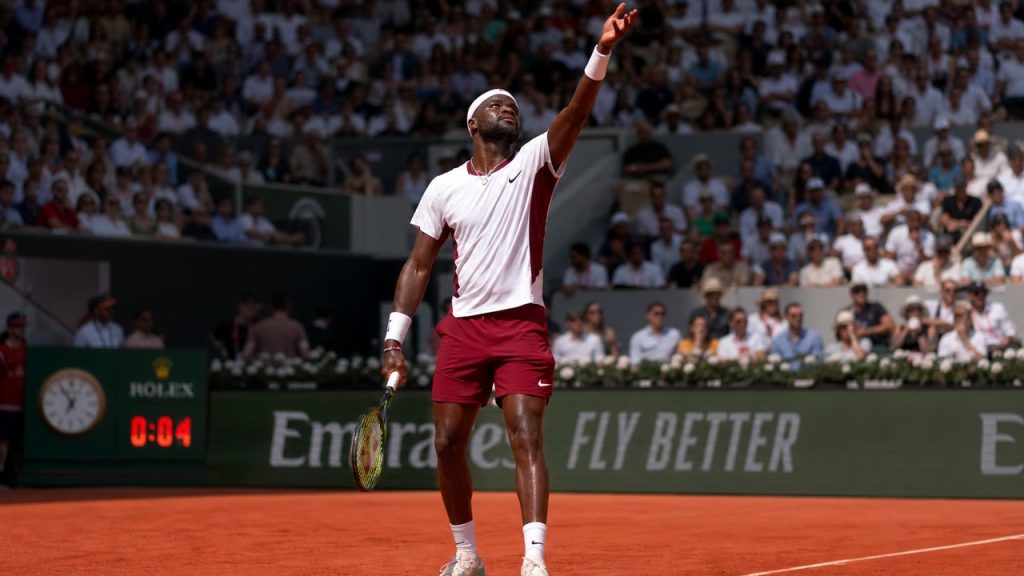

Frances Tiafoe’s best run at Roland-Garros in two years came to a shattering end on Monday night, as the American collapsed from a commanding position in a five-set marathon loss to Matteo Arnaldi, 7-6(5), 6-7(5), 6-3, 7-6(3), 6-4, over five hours and 26 minutes on Court Suzanne-Lenglen. The defeat, sealed just after 1 a.m. Paris time, denied Tiafoe a quarterfinal berth in a wide-open draw that had offered the most realistic path to a Grand Slam semifinal of his career.
The 28-year-old American, seeded 19th at this year’s French Open, had entered Monday’s fourth-round match on the back of two consecutive five-set victories that showcased his revitalized resolve under new coach Dr. Mark Kovacs. Instead, the match became another chapter in the complicated narrative of Tiafoe’s Grand Slam career — one defined by electric talent, passionate crowds, and an inability to close out the biggest moments when they arrive.
A Lead That Dissolved Into Disaster
The final scoreline hardly captures what unfolded over more than five hours on Lenglen. Tiafoe had the match won. Leading 4-1 with a double break in the fourth set, the American then served for the match at 5-4, reaching 30-0 before the wheels came off entirely. Arnaldi, drawing energy from a boisterous contingent of Italian fans, broke back and raced through the tiebreak 7-3 to force a decisive fifth set.
Once in the fifth, there was no route back for Tiafoe. Arnaldi, a 23-year-old Italian ranked No. 104 in the world, produced what he immediately described as the best match of his career. The Italian had spent 17 hours and 42 minutes on court across his four matches to reach the quarterfinal, having also staged comeback victories earlier in the tournament. He will next face fellow Italian Matteo Berrettini in what will be his first-ever Grand Slam quarterfinal.
The Wider Significance for American Tennis
Tiafoe’s exit carries weight far beyond this individual match. His loss means the United States will not have a single men’s quarterfinalist at Roland-Garros for the first time since 2017. Tommy Paul, the other American to reach the fourth round, had already been eliminated. The American men arrived in Paris with genuine optimism — six players made it through to the first weekend — and Tiafoe had emerged as the banner carrier after the early exit of world No. 1 Jannik Sinner and the absence of Novak Djokovic from the draw.
With no Sinner and no Djokovic, a field that will guarantee a first-time Grand Slam champion in Paris on Sunday presented the best opening American men’s tennis had seen at the French Open in years. Second-seeded Alexander Zverev and Matteo Berrettini remain the only Grand Slam finalists still in the men’s draw. Tiafoe had publicly refused to look at the bracket, telling reporters before the Arnaldi match that he was focused only on his next opponent. That discipline ultimately could not compensate for the mental lapses that have come to define his major results.
A Reinvented Player Who Still Falls Short
The loss stings partly because Tiafoe arrived in Paris looking like a genuinely transformed player. At the end of last year, following a third-round US Open defeat, members of his inner circle urged him to either commit fully to maximizing his talent or accept an unremarkable career. Tiafoe responded by overhauling his support staff, hiring Kovacs — a performance physiologist and biomechanics researcher with an unconventional approach to the game — and attacking the 2026 season with renewed purpose.
The results had been immediate. He won the ATP 500 event in Acapulco in February, reached the quarterfinals in Miami in March, made the semifinals in Houston, and arrived at Roland-Garros with a 22-10 match record on the year. At this tournament, he had already needed 14 of a possible 15 sets to reach the fourth round — winning three straight five-set matches, including a comeback from two sets to love down against Jaime Faria. His willingness to grind through brutally long matches had become the story of his 2026 French Open.
Against Arnaldi, the body and mind simply had nothing left when it mattered most. “He’s fighting hard and playing the right way,” Kovacs told broadcasters during the third set, after earlier flagging concerns about his pupil’s shot selection. Tiafoe’s unforced error count spiked at precisely the wrong moments in the fourth set, and his usually powerful first serve deserted him at critical junctures. He had seven set point opportunities in the second set alone, including a 40-0 lead at 5-3, before Arnaldi stormed back to force the tiebreak. That pattern — opportunities created, then squandered — repeated itself with even more painful consequence in the fourth.
What Comes Next for Tiafoe
Despite the brutal manner of the defeat, the broader trajectory of Tiafoe’s 2026 season suggests this is a setback rather than a step backward. He entered Paris ranked 22nd in the world with eight wins on clay this year — his best clay record since turning professional — reflecting a genuine development in a surface that had previously been considered a vulnerability. His coach’s emphasis on movement mechanics and maximizing physical efficiency has paid dividends over a long season.
The question that will follow Tiafoe through the rest of the Grand Slam season is the same one that has dogged him since his breakthrough 2022 US Open semifinal run. The talent has never been in doubt. The ability to convert that talent into major titles — to hold nerve when a quarterfinal is two points away — remains the final frontier. On a night in Paris when the draw was more open than it had been in a generation, Tiafoe found the margin brutally thin between a career-defining result and another painful near miss. Arnaldi was simply the better man on the night, and tennis, as it always does, rewarded the player who refused to blink.