
Bally’s Chicago Tops Off Construction — But the Hard Questions Haven’t Gone Away
The final structural beam is up at Bally's Chicago. The spring 2027 opening target is now in sight. But financing headaches, lender standoffs, and below-expectation revenue at the temporary casino keep the project's path complicated.
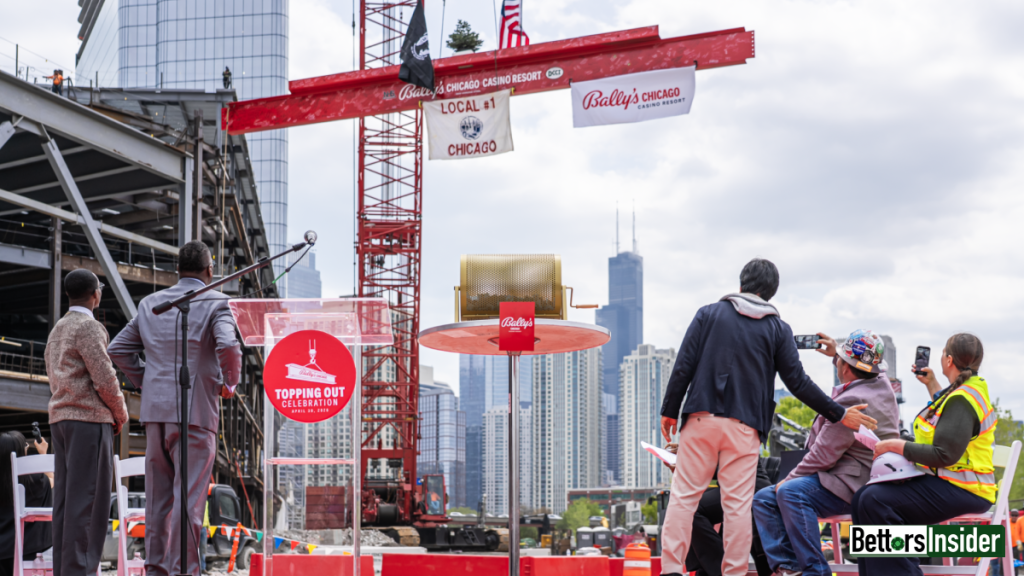

Bally’s Chicago reached a major construction milestone on April 30, 2026, when the final structural beam was hoisted into place at the permanent casino site at 560 W. Grand Ave. in Chicago’s River West neighborhood. The topping-off ceremony drew Chicago Mayor Brandon Johnson, Alderman Walter Burnett Jr., Bally’s Executive Chairman Soo Kim, union leaders, and members of the Chicago Community Builders Collective. The $1.7 billion development is now slated to open in spring 2027, with Bally’s saying it expects to create approximately 3,000 permanent jobs. More than 1,000 tradespeople have worked on the project to date. “This is a significant milestone for Bally’s Chicago,” Soo Kim said at the ceremony, “and reflects the incredible effort of the union trades and partners who have made this moment possible.”
What Topping Off Actually Means
In construction, a topping-off ceremony marks the placement of the final structural element — in this case, a signed steel beam — at the highest point of a building. It signals that the vertical structure is complete and that work can now shift to the building’s exterior, mechanical systems, and interior build-out. For Bally’s Chicago, that means the 35-story hotel tower and the connected casino podium structure are fully framed. The project, situated on the 30-acre former Chicago Tribune Freedom Center site along the Chicago River, will ultimately include 3,400 slot machines, 173 table games, a 500-room hotel, a 3,000-seat entertainment theater, 10 food-and-beverage venues, and 3,300 parking spaces. Interior design is being led by WATG.
The Financing Picture Is Still Messy
The celebratory tone of the topping-off announcement masks a financial backdrop that has been anything but smooth. Last October, a group of Bally’s term loan lenders banded together to block the company’s attempt to amend roughly $1.9 billion in term loans, citing concerns about the value of underlying collateral and the pace of future repayments. At the center of that dispute was Bally’s plan to swap the Rhode Island Twin River Lincoln Casino Resort — which was being sold and leased back for $735 million — as collateral in favor of the under-construction Chicago project. Lenders wanted more detail on how Bally’s intended to manage cash and repay debt. Fitch Ratings placed Bally’s credit rating on negative watch, eventually downgrading it to B-minus, citing elevated execution risk and the company’s high leverage.
The broader financing structure for the Chicago casino rests primarily on a $940 million construction facility provided by Gaming and Leisure Properties, which also acquired the land beneath the project for $250 million and will lease it back to Bally’s for $20 million annually. That arrangement backstops the build, but it does not resolve questions about the company’s overall leverage. Fitch analysts noted that Bally’s EBITDAR leverage hit 7.0 times in 2024 and was projected to climb to between 8.0 and 9.0 times as construction debt and lease obligations compounded.
Temporary Casino Performance Below Expectations
Adding pressure to the picture is the performance of Bally’s temporary casino at Medinah Temple, which has been operating while the permanent site is built. Revenue at the temporary facility has persistently underperformed internal projections. Bally’s CEO Robeson Reeves acknowledged as much in the company’s annual report, writing that “the temporary Chicago casino returns remain below our expectations.” The temporary license from the Illinois Gaming Board was extended to run through September 2026, giving the project a bridge until the permanent facility is ready. Whether the permanent casino can outperform the market dynamics that have constrained the temporary location — a saturated local gaming market, higher-than-average tax rates, and a location that requires consumer habit changes — remains an open question.
What the Project Means for Illinois Gaming
Despite the noise, the Bally’s Chicago project remains one of the most consequential gaming developments in Illinois history. Chicago has never had a full-scale casino, and the city’s pension systems are counting on the revenue share. To date, Bally’s has generated approximately $87 million in revenue for the city through the initial license payment, annual fees, and gaming tax collections from the temporary casino. The permanent facility is projected to generate over $800 million in annual revenue once fully operational, which would make it a significant contributor to state gaming tax receipts on top of the existing Illinois sportsbook and casino market. For Illinois bettors, the arrival of the permanent casino also means a more robust retail sports betting presence in Chicago. Those looking at the current Illinois sports betting landscape can see how the market is positioned heading into Bally’s permanent opening.
Unresolved Questions Heading Into 2027
The topping-off is a genuine milestone, and Bally’s and city officials have been consistent in saying construction and financing are on track. But several questions will define the project’s success beyond the structural completion. The property tax break Bally’s sought — worth nearly $300 million over a decade — remained stalled in Chicago’s City Council Rules Committee as of early 2026. The minority investor program required under the original license agreement has faced legal challenges from groups claiming it discriminates against other investors, and the SEC had not cleared a related public offering. And the company’s broader balance sheet, with multiple capital-intensive projects running simultaneously including a proposed Bronx casino in New York, carries risk that investors and lenders will keep scrutinizing. The beam is up. The harder work — financial, operational, and political — is still ahead.